
Love, Loss and a Sydney Car Park: Inside Davide Di Giovanni’s Unlikely Dance Stage
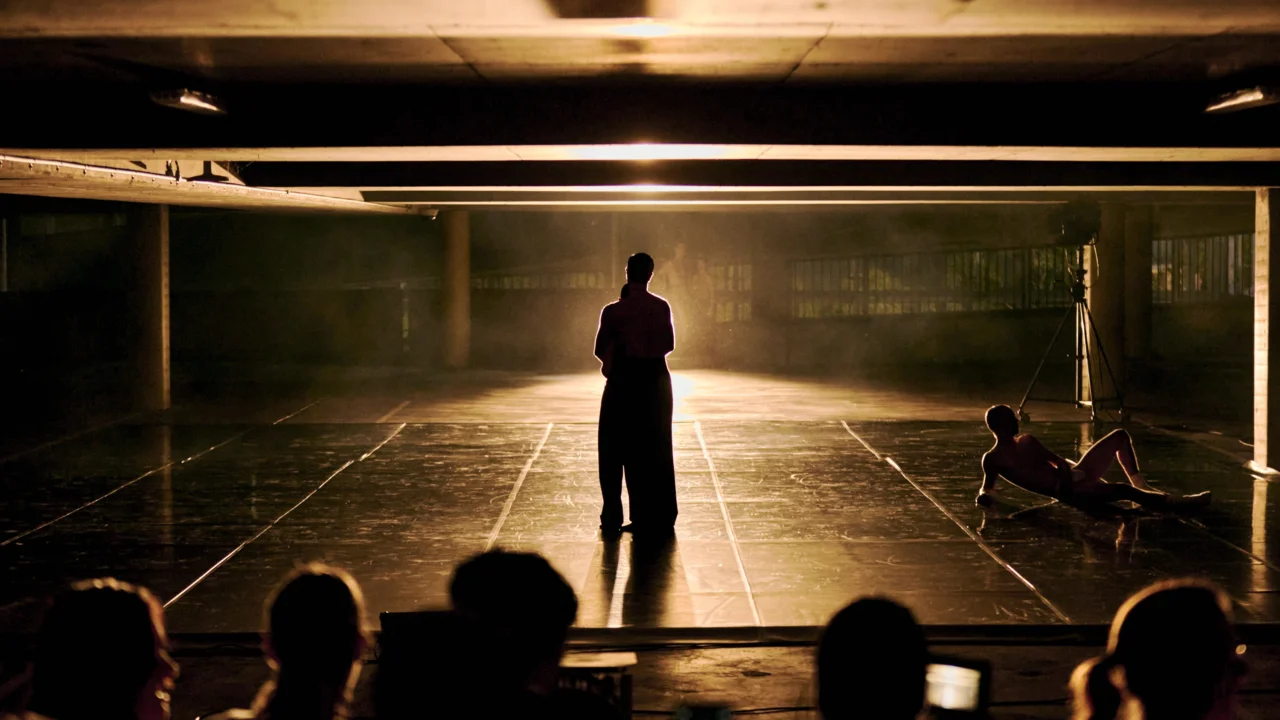
On the fourth level of a Sydney car park, surrounded by concrete, city noise and the occasional sounds of go-karts overhead, choreographer Davide Di Giovanni found an unlikely stage for his exploration of love, memory and the passage of time.
It was a chance discovery. While visiting the Entertainment Quarter to teach, Di Giovanni parked on an empty level and began imagining how its stark architecture might contrast with the romantic, cinematic qualities of his work.
“I park at the level four and it was empty,” Di Giovanni recalls. “And as I saw it that empty and brutal, in a sense, I was like, maybe that could be a great mix with my romanticism.”
That encounter eventually became the foundation for NEW OLD NOW (NON), the contemporary dance company returning to the Entertainment Quarter on November 16 and 17 with And Roses Wilt in the End.
Following three sold-out seasons, the production marks the fourth chapter in Di Giovanni’s continuing exploration of the human experience through movement, music and unconventional performance spaces.
For the ballet-trained artist, the company’s name reflects an ongoing conversation between tradition, experimentation and the present moment.
“I think that the way that I create, the way that I process the work is normally based on searching something new, reflecting on something old,” he explains.
Di Giovanni sees his classical training not as something to move beyond entirely, but as a foundation that continues to inform his contemporary practice.
The name also contains another meaning. When spoken out loud, NON evokes the unknown and the uncertainty that Di Giovanni continually searches for in his work.
That fascination with what cannot easily be defined is particularly evident in And Roses Wilt in the End, a production whose title reflects the fragile relationship between beauty and impermanence.
“It’s, you know, like the beauty of a rose that represent love, sometimes just wilt,” he says.
“We need to understand that time passed and we need to, you know, I keep reflecting on time in my works.”
For Di Giovanni, the image of falling rose petals captures something simultaneously beautiful and confronting about the inevitability of change.
The production also places particular emphasis on the female voice, drawing inspiration from songs performed by Italian singer Mina and Portuguese fado artist Amália Rodrigues.
Although their music comes from different cultural traditions, Di Giovanni was struck by the emotional similarities within their expressions of love.
“They were all suffering from love. They were all saying things about love,” he explains.
“I just realised that it was so nice to hear those different culture and voices talking about the same thing.”
His interest in female voices is also deeply personal.
Di Giovanni credits his mother with shaping his understanding of love, identity and emotional resilience, recalling her support during his childhood.
“I’ve been raised by a woman that is quite strong,” he says. “She supported me through my sexuality when I was a kid.”
For the choreographer, her influence extends beyond family relationships and into the artistic choices he makes today.
“I feel like the female voice is just a guidance to me and represent a lot of my life and who I become now as a man.”
That perspective also informs the casting of Shane Carroll, a former Nederlands Dans Theater performer who embodies a recurring figure representing Time and Memory.
Di Giovanni was drawn to the perspective Carroll could bring as an older performer, particularly the experience and maturity she brings to the role.
“It’s about the maturity of a woman’s voice that can say something that a young one can’t say,” he explains.
Carroll joins performers Conal Francis-Martin, Louis Steinmetz, Malachi Sylvester, Minouche van de Ven and Annaliese Macdonald in the production.
The creative team includes producer Leanne Cherny, lighting designer Mark Dyson, composer Dan Lywood and costume designer Guy Hastie.
Despite the highly personal nature of his work, Di Giovanni is reluctant to prescribe exactly what audiences should feel.
His choreography does not follow a conventional narrative structure. Instead, he creates a sequence of images and emotional moments, allowing audiences to develop their own interpretations.
“I don’t tend to give you a story or a line that you can directly follow during the show,” he says.
“So I just hope that the audience will take one thing from those images and bring it with them.”
That philosophy extends to his relationship with the dancers themselves.
Working with small ensembles of no more than six performers, Di Giovanni encourages each artist to bring their personality and lived experiences into the creative process.
“I want the individual to be very strong and very unique and be able to share what they have personally want to share,” he explains.
The result is a collaborative process in which music, movement and imagery are developed separately before being brought together into a complete theatrical experience.
For Di Giovanni, presenting that work outside a conventional theatre is not simply a stylistic decision. It is also an attempt to challenge assumptions about where contemporary dance belongs.
After decades performing in traditional theatrical environments, he wanted to explore how audiences might respond to dance in places they encounter during everyday life.
The Entertainment Quarter car park offered precisely that opportunity.
“You can hear sounds in the car park that are very city sounds, but matching with the right music. I feel everything works,” he says.
The location’s familiarity is part of its appeal. A place ordinarily associated with routine becomes, for one hour, somewhere audiences can experience something unexpected.
And while NEW OLD NOW’s previous seasons have sold out, Di Giovanni hopes the company’s future will involve expanding access to its performances.
He is interested in exploring additional unconventional locations, returning to traditional theatres and extending performance seasons beyond the current two-night format.
“I would love to do more shows of that and having more support to create more and also give the possibility to people to come and watch,” he says.
Ultimately, however, his ambitions remain rooted in the emotional impact of the work rather than its scale.
“I don’t want people to like my show. I mean, I do want to like my show, but I don’t want only that,” he reflects.
“I want people to just go back home with some feeling in their soul and be able to carry that for a little bit.”
For an artist whose latest production considers the inevitability of things fading, perhaps that is the most fitting ambition of all: to create something that remains with an audience long after the performance has ended.