
Peter Weir Reflects on Mystery, Movies and a Lifetime of Storytelling at Sydney Film Festival
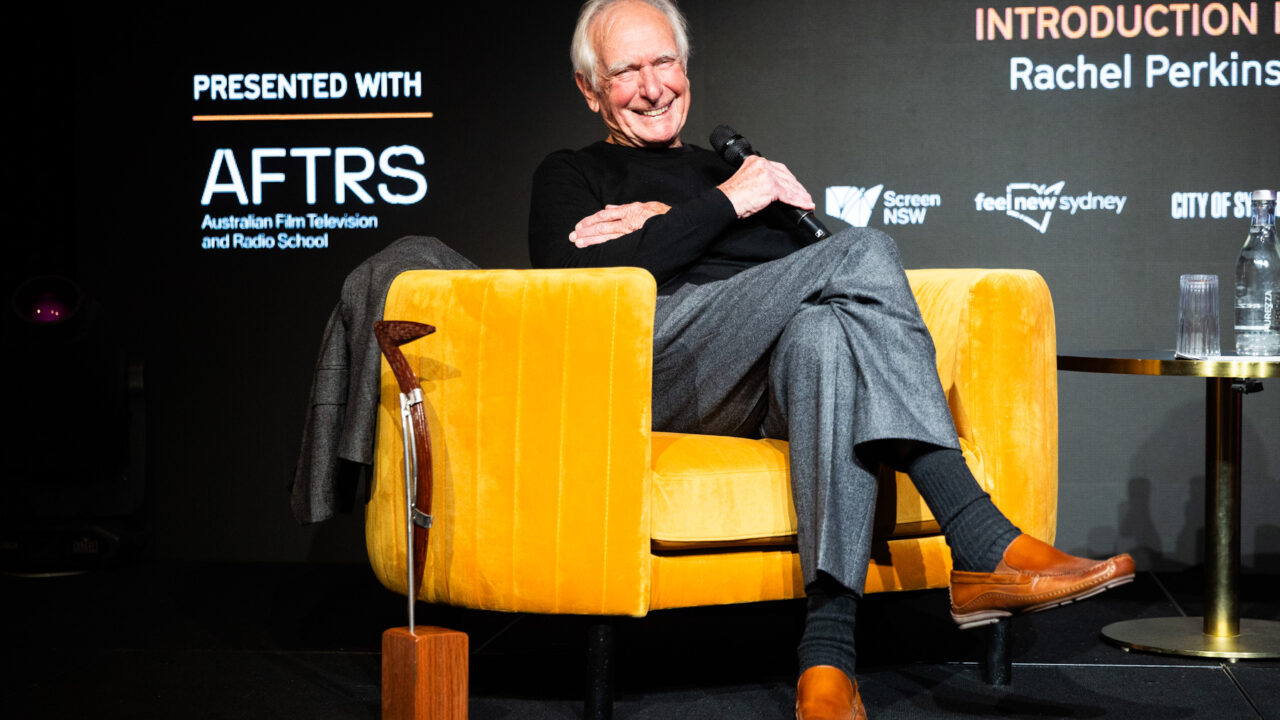
The queue stretched beyond the doors of Sydney Town Hall. Inside, you were hard pressed to find an empty seat. Screen legends Bryan Brown and Miranda Otto were among the filmmakers, actors, students and cinephiles gathered to celebrate one of Australia’s most influential storytellers: Peter Weir.
The sold-out Sydney Film Festival event marked the presentation of the inaugural AFTRS Lifetime Achievement Award to the director of Picnic at Hanging Rock, Gallipoli, Witness, Dead Poets Society, The Truman Show and Master and Commander: The Far Side of the World. For Weir, now 81, it represented another milestone in a career that has shaped both Australian and international cinema for more than five decades, following his Golden Lion for Lifetime Achievement at the Venice International Film Festival in 2024.
Presenting the honour, AFTRS Council Chair Rachel Perkins paid tribute to Weir’s extraordinary contribution to Australian screen culture, describing him as “the greatest filmmaker this country has produced.”
“As Aboriginal people, we felt seen in your films,” Perkins told the audience, adding that Indigenous Australians “hadn’t really had much before your filmmaking came along.”
The remark spoke to the impact of films such as The Last Wave and Picnic at Hanging Rock, which explored landscape, spirituality and identity in ways that broadened perceptions of Australian storytelling.
Held as part of the 2026 Sydney Film Festival, the In Conversation event saw Weir receive the award before settling into an engaging and often surprisingly funny discussion with actor, writer and director Rob Carlton. What followed was less a career retrospective than a masterclass in creativity, collaboration and the mysterious forces that shape great filmmaking.
The evening began with an emotional introduction that framed Weir not simply as an Australian icon, but as a filmmaker whose work helped define Australia’s cultural identity. References to classics including Picnic at Hanging Rock, Gallipoli and The Last Wave drew enthusiastic applause from those gathered, many of whom had grown up with Weir’s films.
Accepting the award, the director reflected on returning to the Australian Film Television and Radio School community more than five decades after first encountering its students.
“I was there in the first year, 1973,” Weir recalled, remembering being invited to spend two weeks with the school’s inaugural intake while completing work on his first feature.
The experience coincided with what he described as the rebirth of Australian cinema and a broader international flowering of filmmaking. He also paid tribute to longtime film critic and festival director David Stratton for exposing Australian audiences and filmmakers to groundbreaking work from around the world.
For all his achievements, Weir repeatedly returned to the idea that filmmaking remains fundamentally unknowable.
Asked why he prefers the simple description “script, shoot, cut” over the industry’s more formal production terminology, Weir offered a glimpse into the philosophy that has guided a career spanning everything from Witness and Dead Poets Society to The Truman Show and Master and Commander.
“There’s something so mysterious about this process,” he said. “We can call it inspiration, whatever you want to call it, but there’s something very old and uncontrollable, unknowable.”
That sense of mystery surfaced repeatedly throughout the discussion.
When Carlton asked about Weir’s approach to screenwriting, the director described the need to completely absorb a script before reshaping it. He recounted working with screenwriter Andrew Niccol on The Truman Show, explaining how he wanted to dismantle the original screenplay and rebuild it in a lighter, more accessible form while retaining its core ideas.
His reflections on collaboration proved revealing. Discussing work with celebrated playwright and screenwriter David Williamson on Gallipoli, Weir rejected the notion of the director as an authoritarian figure.
“I don’t see it like that,” he said. “We’re all trying to reach the ring that’s just out of our reach. I need their help to get us there. The ego lies in the story, not with any individual.”
It was one of several remarks that resonated deeply with the audience, many of whom were emerging filmmakers. Rather than presenting himself as an all-knowing auteur, Weir consistently described filmmaking as a collective pursuit driven by trust, curiosity and instinct.
Music, he revealed, remains central to his creative process.
“If I was an anthropologist, I would argue that before cave drawings there was cave whistling, humming,” he mused, describing music as perhaps the purest artistic expression and the form that most directly accesses the emotional and intuitive side of the brain.
Some of the evening’s most entertaining moments came when Weir shared stories from his celebrated casting career. He recalled discovering Oscar winner Linda Hunt for her groundbreaking role as Billy Kwan in The Year of Living Dangerously, explaining how conventional casting assumptions were discarded once he recognised she possessed exactly the qualities the character required. He also spoke affectionately about working with Robin Williams on Dead Poets Society, describing the improvisational energy that emerged from their conversations and creative rapport.
For Weir, casting has always been about something beyond résumés or auditions.
“I thought of myself as a detective on a missing-person case,” he said. “There’s some sort of non-verbal side to it.”
The director’s fascination with intuition extended to every stage of production. He described deliberately creating space for unexpected discoveries, hiding contingency shooting time in schedules and remaining open to moments of inspiration that could transform a scene. One memorable anecdote involved convincing studio executives to trust his instincts on Witness, including removing two pages of explanatory dialogue from the film’s ending because, as he told them, audiences would already understand what the characters were feeling.
As the conversation moved toward its conclusion, Carlton observed that despite the darkness often present in Weir’s films, audiences frequently leave them feeling hopeful.
The director resisted offering a grand explanation. Instead, he spoke about the need to protect silence during the creative process. During pre-production, he explained, he would often avoid newspapers, television and even other films, creating mental space for intuition to emerge.
“I tried to keep the door wide open for the unexpected idea, the unexpected intuition,” he said.
It felt like an apt summary of a remarkable career.
For close to an hour, the audience was given access not just to one of cinema’s great filmmakers, but to the mindset that produced some of the most enduring films of the last half-century. By the time the conversation ended with a standing ovation, the atmosphere inside Sydney Town Hall felt less like an awards presentation and more like a communal expression of gratitude.