
Tim Curry, ‘Rocky Horror,’ ‘Clue’ and ‘It’ Star, Dies at 80
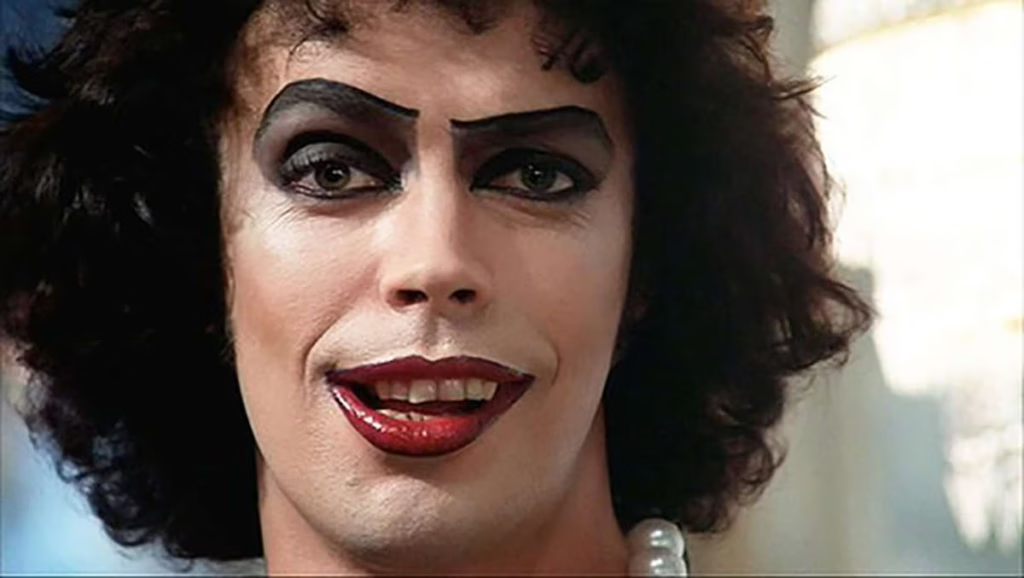
The British actor created one of cinema’s great cult characters as Dr. Frank-N-Furter before terrifying another generation as Pennywise the clown.
Tim Curry, the British actor whose gleefully theatrical performances in The Rocky Horror Picture Show, Clue, Legendand Stephen King’s It made him one of the most distinctive screen performers of his generation, has died. He was 80.
Curry died Tuesday night at his home in Los Angeles, his longtime manager and friend Marcia Hurwitz confirmed. No cause of death was disclosed. The actor had experienced significant health problems since suffering a stroke in 2012 that affected his mobility.
For all the breadth of a career that stretched across theatre, film, television, music and voice acting, Curry remained forever associated with the role that made him a star: Dr. Frank-N-Furter in The Rocky Horror Show and its 1975 film adaptation, The Rocky Horror Picture Show.
It was a performance that transcended the film itself. Curry’s entrance in corset, stockings and heels became one of the defining images of cult cinema, while his combination of danger, sexuality, comedy and rock-star swagger helped turn a film that initially struggled commercially into an enduring midnight-movie phenomenon.
Curry originated Frank-N-Furter in Richard O’Brien’s The Rocky Horror Show at London’s Royal Court Theatre in 1973 before reprising the role on stage in Los Angeles and Broadway and then in Jim Sharman’s film, alongside Susan Sarandon, Barry Bostwick and Meat Loaf.
More than half a century later, The Rocky Horror Picture Show remains inseparable from the actor who first brought its flamboyant mad scientist to life.
Yet Curry consistently resisted being defined by a single character.
In 1982’s Annie, he played the scheming Rooster Hannigan opposite Carol Burnett and Bernadette Peters. Three years later he delivered another performance destined for cult status as the increasingly frantic butler Wadsworth in Jonathan Lynn’s Clue.
Curry’s breathless reconstruction of the murders during the climax of Clue became a showcase for the physical precision, timing and controlled theatricality that characterised much of his best work. Like Rocky Horror, the movie was initially a box-office disappointment before finding an enthusiastic audience in the years that followed.
Ridley Scott found another use for Curry’s ability to disappear into a role in 1985’s Legend. Buried beneath elaborate prosthetics, Curry played the demonic Darkness opposite a young Tom Cruise, creating one of the decade’s most memorable fantasy villains.
Then came Pennywise.
In the 1990 television adaptation of Stephen King’s It, Curry transformed the seemingly innocuous image of a circus clown into nightmare fuel for a generation. His Pennywise could move from playful to malevolent in an instant, with Curry relying as much on his voice, eyes and wicked humour as the character’s makeup to create the sense that something monstrous was lurking underneath.
His other screen credits included The Hunt for Red October, Home Alone 2: Lost in New York, The Three Musketeers, Congo and Muppet Treasure Island, while his instantly recognisable voice led to an extensive second career in animation and video games.
Theatre, however, remained central to Curry’s career.
Born Timothy James Curry in Cheshire, England, on April 19, 1946, he studied English and drama at the University of Birmingham before making his professional breakthrough in the London production of Hair in 1968.
Curry went on to earn three Tony Award nominations. He was recognised for playing Wolfgang Amadeus Mozart opposite Ian McKellen in Amadeus, for the musical My Favorite Year, and for playing King Arthur in the original Broadway production of Monty Python’s Spamalot.
He was also a recording artist in his own right. Between 1978 and 1981 Curry released three albums — Read My Lips, Fearless and Simplicity — demonstrating that the formidable rock voice heard in Rocky Horror was hardly an affectation created solely for Frank-N-Furter.
His career changed dramatically after a major stroke in 2012 left him reliant on a wheelchair. Curry nevertheless continued voice work and public appearances, maintaining a relationship with generations of fans who had discovered him through very different corners of his career.
He also returned to the world that made him famous in Fox’s 2016 television production The Rocky Horror Picture Show: Let’s Do the Time Warp Again, this time appearing as the Criminologist.
Curry published his memoir, Vagabond, in 2025. In the book he reflected on the distinction between his own personality and the extravagant characters with whom audiences had associated him for decades.
Tributes following his death reflected the extraordinary reach of his career. Carol Burnett, who appeared with Curry in Annie, remembered him as a performer uniquely capable of making villains lovable, while Rocky Horror creator Richard O’Brien, Susan Sarandon, Kiefer Sutherland and Luke Evans were among those paying tribute.
Curry was never a conventional leading man, and that ultimately became one of his great advantages. He could be seductive, sinister, absurd, frightening or very funny — sometimes within the same performance. He seemed naturally drawn to characters operating several degrees beyond normality and possessed the rare ability to make theatrical excess feel completely controlled.
Frank-N-Furter may have ensured Tim Curry would never be forgotten. But Clue, It, Legend, Annie, Spamalot and the rest of his remarkably eclectic career proved there was far more to him than the role that made him famous.
He leaves behind a gallery of outsiders, eccentrics and villains that few actors could have played — and fewer still could have made quite so unforgettable.