
Inside Ragnar Kjartansson’s Mercy
The Icelandic artist’s first major Australian exhibition is an unforgettable meditation on music, memory, melancholy, beauty, violence and the fragile grace that binds them all together.
By Sean Sennett
Few contemporary artists balance melancholy and joy quite like Ragnar Kjartansson.
Walking through Ragnar Kjartansson: Mercy at the National Gallery of Victoria, visitors move between music, longing and faded grandeur. Beneath the beauty lies something darker: history, power, violence and the uneasy suspicion that civilisation itself may be another elaborate performance.
The Icelandic artist’s first major Australian exhibition brings together eight new and recent video works, including the monumental nine-screen installation The Visitors, alongside immersive films and environments that reveal an artist fascinated by the fragile line between elegance and unease.
Speaking at the NGV during a walk through the the exhibition, Kjartansson laughs as he recalls arriving after the long journey from Reykjavík.
“You travel for 32 hours and suddenly realise Western culture has taken over the world,” he says. “You arrive in Melbourne and everything feels strangely familiar. There’s hardly a difference between places anymore.”
It is an observation that echoes throughout the exhibition. Whether set in Iceland, Germany, Moscow, New York or the American countryside, Kjartansson’s works are united by architecture, music and cultural rituals that feel both comforting and quietly unsettling.
Touching down in Melbourne on the day the exhibition opened, George Michael’s Careless Whisper drifted through the airport, prompting Kjartansson to reflect on the universality of popular culture.
“It’s everywhere,” he says. “It suddenly makes you realise how these things connect the entire world.”
At the emotional heart of Mercy sits The Visitors, the extraordinary 2012 installation that established Kjartansson as one of contemporary art’s important voices.
Filmed in real time at Rokeby Farm, a 19th-century mansion in upstate New York, the work places musicians in separate rooms throughout the house—a drummer in the kitchen, a banjo player in the library and Kjartansson himself singing from a bathtub—before gradually bringing them together in a euphoric musical finale.
The lyrics were written by artist Ásdís Sif Gunnarsdóttir, Kjartansson’s former partner.
“We were splitting up at the time,” he says. “A lot of things came together. First there was the song, then the music grew into something larger.”
Working alongside composer Davíð Þór Jónsson and a collective of Reykjavík musicians, the work evolved during an intense week of rehearsals and filming. The title, he adds, came via the ABBA song of the same name.
Like ABBA’s finest recordings, The Visitors transforms personal heartbreak into something communal and unexpectedly uplifting.
“They are the masters of it,” he says. “That yearning. The Visitors is so icy. Such a good song.”
Later, Kjartansson reveals his favourite ABBA song is “S.O.S.”Throughout Mercy, beauty repeatedly conceals something darker.
“I always feel everything is loaded with violence. Everything is saturated with it.”
The artist returns to ballerinas, children and aristocratic interiors that quietly suggest histories of privilege. The same privilege can mask social discomfort and occasional violence.
There’s a film depicting affluent German children near Munich. Watching it, you can’t help but think of the Second World War, which loads the image with subtext.
Another work was filmed inside New York’s legendary 21 Club. His performers often appear suspended in carefully composed tableaux, moving so subtly they seem almost frozen in time.
“It’s a creepy place,” Kjartansson says. “It’s where Donald Trump celebrated after he was first elected. The spaces I use are loaded with meaning.”
Among the exhibition’s newest works is Sunday Without Love (2025), making its Australian premiere at the NGV.
Inspired by a postcard hanging on Kjartansson’s refrigerator, the film features 10 performers dressed in anonymous European folk costumes repeatedly singing the haunting refrain: “You must learn to live without love.”
Like much of his work, it is simultaneously funny, hypnotic and quietly devastating—a living painting brought to life through music, repetition and performance.
Many of Kjartansson’s moving images resemble classical paintings—stately in both composition and mood.
“I really like stately paintings,” he says after mulling for a moment. “That’s actually a very good word.”
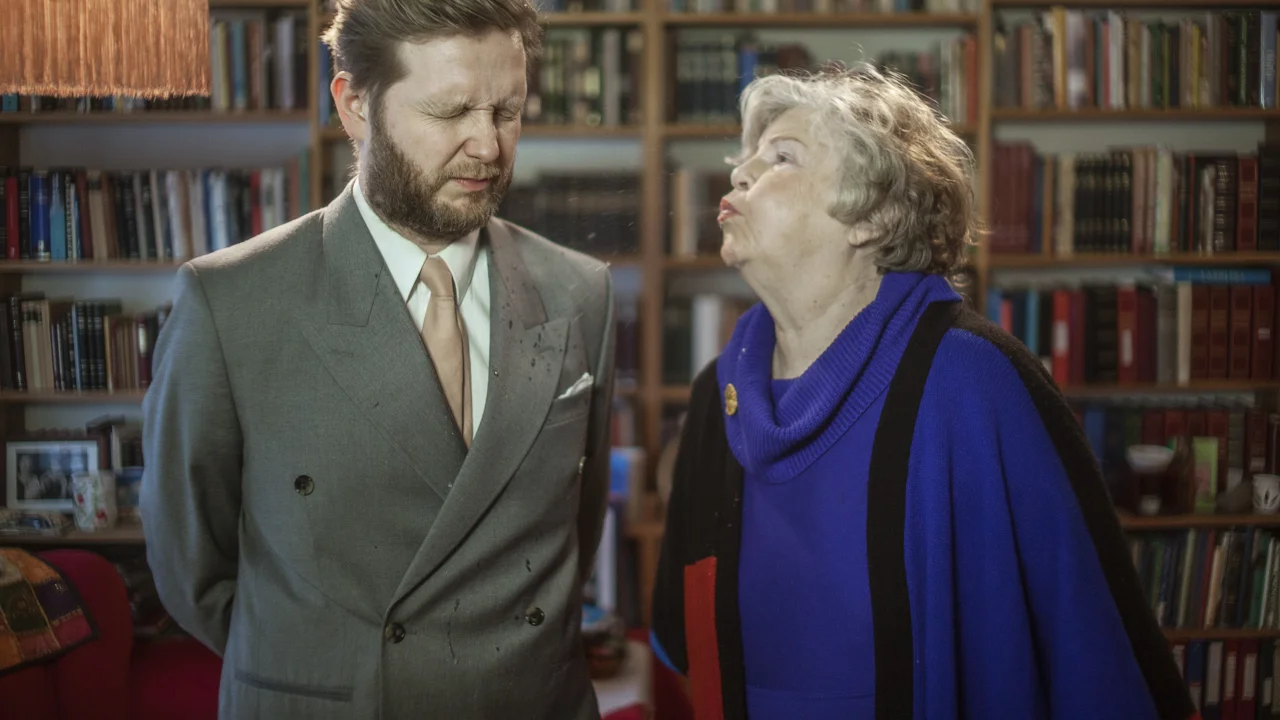
Perhaps the exhibition’s most affecting work is Me and My Mother, an ongoing project in which, every five years, Kjartansson asks his mother, acclaimed Icelandic actor Guðrún Ásmundsdóttir, to spit on him.
Watching the work today, he sees something unavoidable.
“We are ageing,” he says quietly.
He describes the project as a memento mori.
“You see yourself and your mother getting older. It makes you realise that we’re approaching it.”
Throughout Mercy, music ends. Relationships end. Youth disappears. Families change. Art preserves the moments that would otherwise vanish.
Before becoming one of the world’s leading contemporary artists, Kjartansson imagined music would be his career.
“I was very ambitious about music,” he says. “But art was the thing I did for fun. I had freedom because I wasn’t trying to build a career. Now, I make bands around works.”
As for ‘Mercy’ itself, the exhibition’s title carries emotional and spiritual weight.
“It has Christian connotations,” Kjartansson says. “But I always feel it’s a slightly violent word. “Mercy, after all, exists only because punishment remains possible. What happens if you don’t show mercy? It’s fire and brimstone.”
That tension—hovering between tenderness and threat, beauty and violence, joy and sorrow—defines every room of the exhibition.
The NGV’s companion exhibition, Children’s Play: Ragnar Kjartansson, reflects his lifelong fascination with theatre and imagination.
“It’s a magical feeling to walk onto a set,” he says. “You enter the make-believe.”
Visitors leave Mercy carrying more than images of musicians, dancers, children, mothers, lovers and old friends. They leave with the understanding that memory fades, time moves quickly and every act of grace exists because something harsher may be waiting just beyond it.
Ragnar Kjartansson: Mercy and Children’s Play: Ragnar Kjartansson will be on display from 26 June – 4 October 2026 at NGV International, St Kilda Road, Melbourne.
ENDS