
From Every Corner of Australia: Meet Netflix’s ‘Next Brilliant Career’ Finalists
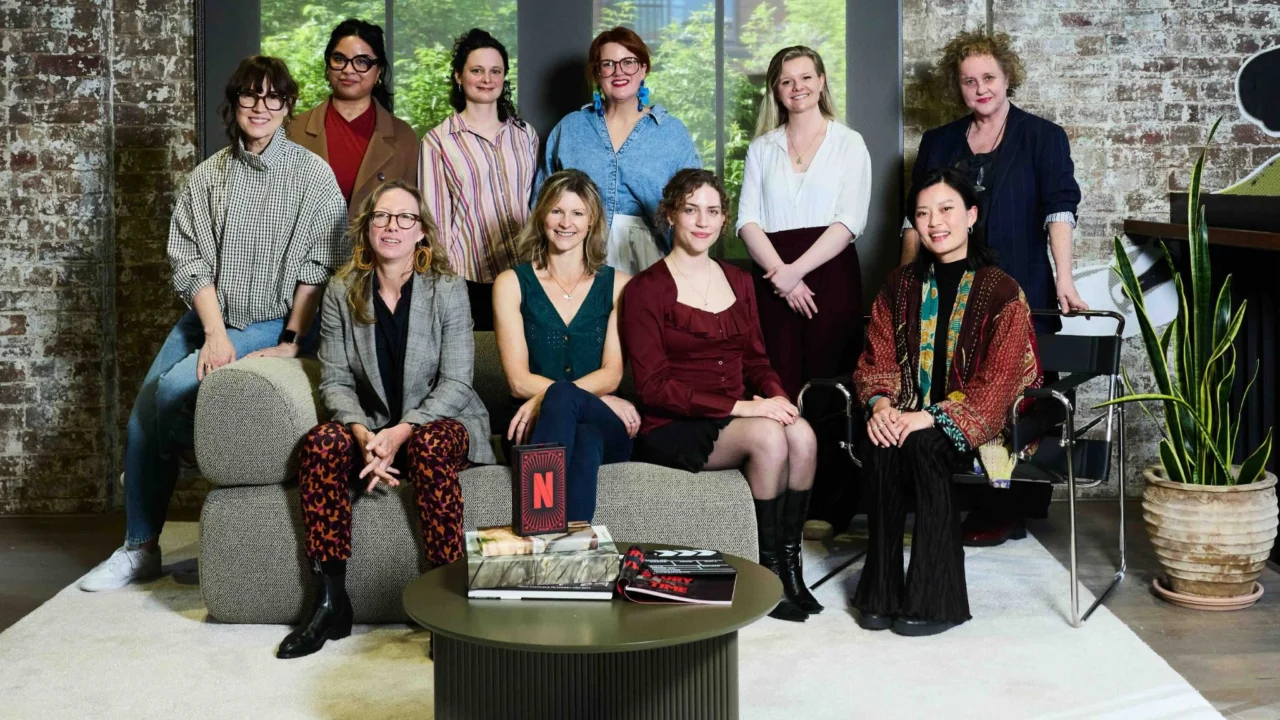
Eight emerging writers representing every Australian state and territory travelled to Netflix’s Sydney headquarters to pitch original projects—and make the case for stories grounded in culture, geography and lived experience.
Inside Netflix’s Sydney headquarters, eight emerging screenwriters have gathered from every corner of Australia. They have travelled from capital cities and regional centres, from Tasmania and the Northern Territory to Western Australia, each carrying an original project—and the hope that a roomful of Netflix executives might help move it closer to the screen.
The writers are the national finalists in The Next Brilliant Career, a new initiative created by Netflix ANZ in partnership with the Australian Writers’ Guild and Australia’s eight state and territory screen agencies.
New South Wales is represented by Elyse Landsberry, with Theresa Angela selected from Victoria, Rae Choi from Queensland, Scarlett Scherer from South Australia, Jamey Claffey from Western Australia, Caitlin Richardson from Tasmania, Rebecca Parker from the Northern Territory and Denai Grace from the Australian Capital Territory.
Each finalist was invited to pitch an original scripted concept to Netflix ANZ’s content team and receive direct feedback on its development and potential for the screen.
The writers were selected through an independent assessment process led by the Australian Writers’ Guild, with submissions evaluated on the distinctiveness of the writer’s voice, the strength of the central premise and the project’s capacity to sustain a feature or series.
The initiative takes its name and inspiration from pioneering Australian author Miles Franklin, who wrote My Brilliant Career as a teenager and fought to tell stories on her own terms. It was launched alongside Netflix’s forthcoming adaptation of Franklin’s novel and is designed to create a direct pathway for emerging women and non-binary storytellers.
Yet if there is a common thread connecting the eight finalists, it is not a shared genre or a single idea of what an Australian story should look like. It is their determination to resist being reduced to a stereotype.
Stories That Refuse to Be Flattened
Filipino-Australian writer, director and visual artist Theresa Angela came to filmmaking through music, dance, acting and visual art. She enrolled in film school as a mature-age student during the pandemic, discovering a medium in which her different creative practices could finally converge.
Her short films—including The Holy Whore, Yes Sir/Sorry Ma’am and Flaccid—draw upon dark humour, surrealism and culturally specific experiences. Angela cites David Lynch as an obvious influence but also sees absurdity as something embedded in Australian filmmaking.
“I’m really interested in seeing stories on screen where characters have a specific cultural nuance that can’t be flattened or tokenised,” Angela says. “Working in the community arts scene with multicultural creatives, I think there’s such a yearning for authentic representation—where we’re not flattened into something that’s easy to consume for mainstream audiences.”
For Angela, maintaining an individual voice does not mean resisting collaboration. It means finding people capable of extending that vision.
“I have a really strong sense of voice and tone and authorship, but I know the importance of being held accountable to your collaborators,” she says. “I’ve been fortunate enough to find collaborators who share similar visions and values. That’s where the magic happens, because they build upon what was your vision and add something on top of it.”
Queensland finalist Rae Choi also understands the desire to create stories that were missing from the screen during her formative years.
The Chinese-Australian writer, director and producer began her professional life as a lawyer before moving into filmmaking. Her debut short as writer-director, When the Sky Was Blue, was nominated for an Australian Writers’ Guild Award and a Screen Producers Australia Award before streaming on SBS On Demand.
Her latest short, Some Kind of Blue, was inspired by her experience of discovering that she was hard of hearing and by the sensation of living between different worlds.
“I grew up feeling like there wasn’t much out there that I actually resonated with,” Choi says. “That created this deep yearning to find those stories—and if I can’t find them, write them myself.”
That sense of being between worlds runs through Choi’s work: between cultures, careers, modes of communication and different ideas of belonging. Even her recurring references to nature and the colour blue have a personal history. The titles When the Sky Was Blue and her feature project Days Under the Sun originated in expressions used by her mother.
There may also be a filmmaking connection running through the family. Choi discovered in her twenties that the grandparents she never met had worked in Hong Kong movie studios.
“There’s something about that which made me wonder if it just skipped a generation,” she says.
Choi is currently undertaking an extended attachment with filmmaker Robert Connolly on his forthcoming feature Shiver, working across development, pre-production, the shoot and post-production. She is also developing the dark comedy In Her Body and her debut feature, Days Under the Sun.
Learning by Making
New South Wales finalist Elyse Landsberry has already made the leap into feature filmmaking.
A recent AFTRS graduate, Landsberry wrote, directed and edited her debut feature Black Prince, an eco-horror film featuring Australian screen veteran Jack Thompson. Securing Thompson initially appeared a long shot, until Landsberry was advised to write him a letter explaining the project.
Thompson responded to the screenplay and its environmental themes, agreeing to join the production for three days.
“The crew were all in our twenties, and when he came on set everything changed,” Landsberry says. “We were a schmick machine because we wanted to be good for Jack Thompson. We juiced as much out of him as humanly possible. We got our three days’ worth.”
The experience marked a considerable step forward for Landsberry, who began making films with her brother, running into national parks with a family camcorder. She has since written and directed more than 10 shorts, including the proof-of-concept Miss Trial, which won Best International Film at the Atlanta Women’s Comedy Film Festival.
For Landsberry, short films were both an accessible point of entry and a way of discovering her creative identity.
“It’s a really good way of getting into long form,” she says. “It’s also a really good way of understanding what genres you love and what characters you love.”
Her experiments have included animation, despite having no experience in the form when she first pitched an animated project at AFTRS. To convince sceptical tutors that she could complete it, Landsberry created a brief test animation. The idea attracted a crew, became a finished short and was ultimately picked up by SBS.
With Black Prince beginning its festival journey, Landsberry is now developing several features and the series she pitched to Netflix, with a strong female perspective providing the link between them.
For ACT finalist Denai Grace, the possibilities of genre emerged from a childhood spent moving between radically different environments.
Grace lived in the jungles of Papua New Guinea, the Canadian wilderness and the streets of Hong Kong before she had settled into formal schooling. That experience fostered an enduring fascination with other worlds, languages and cultures—and eventually with horror, science fiction and fantasy.
“I spend hours, months, sometimes even years just thinking about the world I’m creating, the characters who might live there, what the laws of that world are and what kinds of stories would emanate from living in those places,” Grace says. “I love immersing myself in storytelling where we’re not anchored in reality. Anything can be possible.”
Grace’s credits include The Staircase, an episode of the horror anthology Deadhouse Dark, which was selected for Canneseries and released internationally through Shudder. She has also produced features selected for SXSW and Raindance and written, directed and produced the science-fiction short EXO226.
Her process changes according to the demands of each project. Some ideas sit for months before the missing element arrives; another screenplay emerged in a week after the story had been forming internally for far longer.
Grace also resists deciding too early whether an idea belongs in a feature or episodic format. One current project began as a feature trilogy, but industry feedback consistently suggested the world was large enough to sustain a series.
“Sometimes you don’t know what you’ve got until you start writing it,” she says. “Then you realise the feature is too restrained and isn’t the right format for this. You have to expand the world, and sometimes you need to go through the process to figure that out.”
The View From Outside Sydney
The national reach of The Next Brilliant Career is significant in an industry still heavily concentrated around Sydney and Melbourne.
Tasmanian finalist Caitlin Richardson created and wrote the acclaimed 2021 SBS web series The Tailings, which received recognition from the AACTA Awards, the Australian Writers’ Guild, Screen Producers Australia and Melbourne WebFest.
Richardson lives and works on Muwinina Country and describes Tasmania’s creative community as close-knit, multidisciplinary and shaped by the particular character of the island.
“The landscape probably shapes people—how they operate in the world and how they see the world—and therefore it shapes their creative work,” Richardson says.
Because Tasmania has a relatively small screen sector, its filmmakers frequently intersect with visual artists, musicians, theatre practitioners and people working in other forms. Richardson sees the limitations of scale producing a certain resourcefulness, with artists finding different outlets for their creative energy.
Alongside her writing, Richardson works as a teacher. Although balancing paid employment with screenwriting can be difficult, she regards the classroom as another source of creative renewal.
“It’s a real joy being around young people who have fantastic talents, skills, ideas and interesting insights about the world,” she says. “Part of the creative challenge is working out how you shift between different roles and how you can be creative with the little windows of time you do have.”
Richardson is continuing to develop projects for the screen while remaining open to theatre, radio and other forms.
South Australian finalist Scarlett Scherer, meanwhile, believes she is working in Adelaide at a transformative moment for the state’s screen industry.
A writer and director working on Kaurna Land, Scherer has studied through NIDA, AFTRS, UCLA and the Sundance Institute, while her short films have screened at Adelaide, Flickerfest, St Kilda and the Melbourne Queer Film Festival.
She also worked as a director’s assistant to Anne Renton on Netflix’s My Brilliant Career, eventually being given the opportunity to direct a breakaway unit.
“It’s encouraging to work with established creatives who understand that you’re not only there to shadow, watch and learn,” Scherer says. “At some point, you need to have your own opportunity to try to do the thing—to be the one calling cut. That’s when you really learn, when people champion you and fight for you to have your chance, rather than leaving you on the sidelines.”
Scherer now works as an assistant to filmmaker Sophie Hyde at Closer Productions, where she is developing a debut feature set in Berlin. For the Netflix initiative, however, she pitched a distinctly Australian miniseries.
Her work frequently explores queer experience, something she considers an inevitable extension of writing from personal truth.
“I’m a queer person, so if you’re someone who likes to tell stories about your lived experience, that’s always going to come through on screen,” she says. “Australia has some really special queer-focused film festivals and channels for people to tell stories and connect with the audiences they’re made for.”
Scherer says increased funding, attachment opportunities and support for emerging filmmakers have created genuine momentum in South Australia.
“I feel like I’m in the right place at the right time,” she says. “You can feel that the South Australian Film Corporation is really trying to invest in South Australian talent and encourage people to stay.”
Romance, Conflict and the Long Road
Western Australian finalist Jamey Claffey arrived at the pitch day with experience inside some of the industry’s most established story departments.
Claffey has worked in script and story-editing roles across BBC television drama commissioning, BBC Studios and BBC Radio 4. Since returning to Australia, she has consulted on Audible originals and worked on drama projects for Golden Pineapple Pictures and Dreamchaser Entertainment.
Her project for Netflix is a comedy-romance series set in the Western Australian wheatbelt.
“I love serial stories,” Claffey says. “I need to be able to see the series arc. I need to see the worst point in the middle and know where we’re going to end. All the tent poles need to be in place before I would pitch it.”
Claffey believes comedy becomes immeasurably stronger once it is tested with collaborators. A joke may appear effective on the page, but the writer only truly discovers whether it works when it reaches a room.
As for recurring declarations about the revival of the romantic comedy, Claffey rejects the premise.
“It’s never gone,” she says. “People feel funny about calling it a rom-com now, so they call it the romance genre. But romance is still the number-one-selling genre in the world and always has been.”
The familiar Hollywood romantic comedy may have taken a temporary break, she concedes, but the audience’s appetite for love stories never disappeared.
Northern Territory finalist Rebecca Parker brings a markedly different range of experiences to her screenwriting.
After studying directing at AFTRS, Parker worked on a film about the Balibo Five in Timor-Leste. When conflict erupted, she began filming and was drawn into a career as a photojournalist and political adviser, working across Southeast Asia and the Middle East.
Although it took her away from the dramatic filmmaking she had initially intended to pursue, Parker now regards those years as an education in the subjects that continue to animate her writing.
“If you want to learn about conflict, human relationships, power and politics—all the things I’m interested in—I had the masterclass in it,” she says.
Parker later co-founded Honey Ant Productions with Eastern Arrernte filmmaker Samantha Laughton to develop female-led, First Nations and regional stories. In the Territory, where the production community is small, specialising in a single role is not always possible. Parker has worked as an assistant director, stills photographer and producer on visiting productions, while continuing to write and direct her own material.
That necessity has broadened her understanding of the entire production process.
“You round out your skill base because of the nature of the work,” she says. “I think that has actually been positive for my development as a writer-director, because you know the breadth of your crew. You know what they’re doing because you’ve done those roles to some degree.”
It has also taught her the necessity of keeping several projects alive at once. Development is slow, financial security is rare and the demands placed upon filmmakers can be punishing.
“It’s a very slow and very long road, and you have to really want it,” Parker says. “Hardly anyone makes any money. We do a lot of work for nothing, we juggle all these balls and it’s not good for families. You cannot want to be in this industry unless you absolutely have to.”
Finding the Next Brilliant Career
Amanda Duthie, Netflix ANZ’s content director, says the finalists embody the purpose of the initiative: identifying voices that deserve to be amplified, supported and nurtured.
“We’re grateful to our partners, the Australian Writers’ Guild and every state and territory screen agency, for believing in this initiative and for their support in creating a tangible direct-to-screen opportunity for Australian women and non-binary screenwriters,” Duthie says.
Australian Writers’ Guild director of professional development Susie Hamilton says emerging writers rarely receive the opportunity to pitch directly to a global streaming platform and receive detailed feedback.
“That process is so important to their growth as industry practitioners and to the development of high-quality, authentically Australian television,” Hamilton says.
Netflix says it has invested more than $10 million in industry capacity-building through training, on-the-job programs and partnerships with organisations including AFTRS, NIDA and Lumina, as well as attachment programs on Australian productions.
For the eight finalists assembled in Sydney, however, The Next Brilliant Career is about more than one meeting or one pitch. It is an acknowledgement that Australian storytelling is not located in a single city, culture, genre or professional pathway.
It can emerge from the wheatbelt, from an Adelaide film set or a Tasmanian classroom. It can begin in a Hong Kong studio two generations earlier, in the hands of a child carrying a camcorder into the bush, or in the middle of a conflict zone with a camera already rolling.
What connects these eight writers is their insistence upon making the stories they have not yet seen—and their willingness to undertake the long, uncertain work required to bring them to the screen.