
‘Mortal Kombat II’ Director Simon McQuoid on Going Bigger, Johnny Cage and Learning From Round One
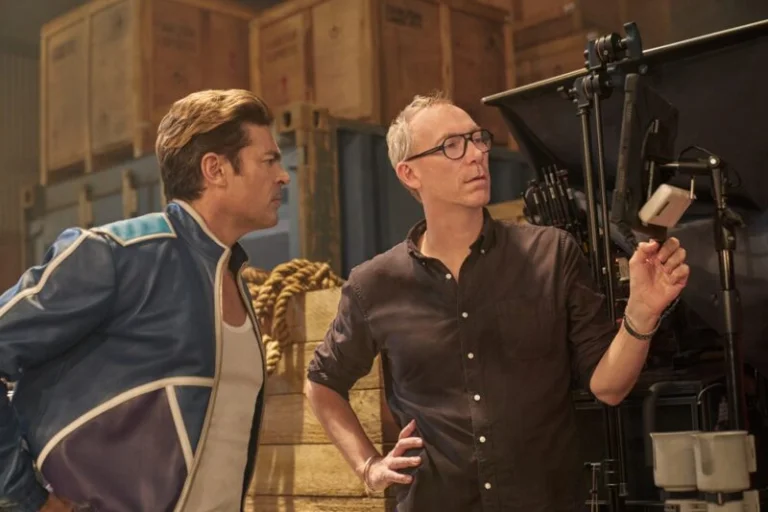
Simon McQuoid arrived on the Gold Coast sounding like he’d survived a fight with Sub-Zero.
“You’ll have to excuse my crackly voice,” the Australian director says, laughing off a cold he picked up after a Las Vegas panel with Mortal Kombat co-creator Ed Boon. “It’s not Ed’s fault,” he adds. “The next morning I woke up in L.A. and I was like, ‘Oh…’”
McQuoid is on the promo tour for Mortal Kombat II, the latest New Line Cinema instalment in the long-running video game franchise created by Boon and John Tobias. The sequel brings back the champions of Earthrealm and adds one of the series’ most anticipated characters: Johnny Cage, played by Karl Urban.
For McQuoid, shooting a sequel to his 2021 Mortal Kombat feature was an opportunity he wasn’t going to miss.
“It’s a real privilege and a joy to be able to swing like this — to go bigger and more epic, and to learn from what happened on the first one,” he says of stepping back into the arena.
Looking back, he didn’t wait long to start thinking about round two.
“I gave myself a month off and then I started working on it,” he says. “It was like: ‘Here’s what we did well. Here’s what we could do better. Here are the characters I want. Here are the worlds I want to go to.’”
“You learn where you can improve,” he adds. “Then you get this incredible, rare opportunity to say, ‘All right — we’re going again.’”
That sense of expansion runs through the new film, which pits the fan-favourite champions against the dark rule of Shao Kahn in a gory, no-holds-barred fight for Earthrealm’s survival. The cast includes Adeline Rudolph, Jessica McNamee, Josh Lawson, Ludi Lin, Mehcad Brooks, Tati Gabrielle, Lewis Tan, Damon Herriman, Chin Han, Tadanobu Asano, Joe Taslim and Hiroyuki Sanada. Jeremy Slater wrote the screenplay, with McQuoid returning to direct.
The scale was considerable. McQuoid estimates the production shot “somewhere between 75 and 90 main-unit days,” alongside additional second-unit work.
“It’s full-on,” he says. “I mean, I love it. I absolutely love it. So it never really feels like work to me.”
That attitude perhaps explains one of the more unusual career paths in contemporary franchise filmmaking. Mortal Kombat was McQuoid’s feature debut. Mortal Kombat II is only his second film.
Before cinema, he was a graphic designer from Perth.
“That’s what I studied,” he says. “I love design. I love typography. I love films. I’ve always loved film. I’ve always wanted to be in it. But when you grow up in an outer suburb of Perth, the idea of becoming a film director is like saying, ‘I want to fly to Mars.’”
Advertising became the bridge. McQuoid began directing commercials, deliberately steering himself toward large-scale cinematic work, including campaigns for Halo, PlayStation and Call of Duty.
“I specifically made sure I got myself into a place where I could do huge commercials — things that had cinematic scope,” he says. “I was always thinking about movies. It’s my default setting.”
That background helped close what he calls “the gap of risk” for a studio taking a chance on a first-time feature director.
“After I’d done all these video game commercials, it became a smaller leap for them,” he says. “‘Oh, well, that makes sense. You can do the Mortal Kombat film.’”
For the sequel, McQuoid worked closely with Slater on the script.
“Jeremy got there very quickly,” he says. “He’s an incredibly talented writer. I’d say, ‘I want this, I want these characters, how are we going to do the tournament?’ And he was like, ‘Okay, I got it.’”
One of the biggest additions is Johnny Cage, teased at the end of the 2021 film and now played by Karl Urban as a swaggering Hollywood action star. McQuoid says the character needed more than quips.
“Johnny needed to go on a journey,” he says. “He needed to start at a very low point. Both Kitana and Johnny begin the movie in a pretty low place. All of the characters needed to start in one place and end in another.”
That arc, he says, gave audiences “a way of relating to the characters” inside an otherwise heightened, surreal universe.
Then there is Hiroyuki Sanada, returning as Scorpion. McQuoid’s admiration is obvious.
“He’s the sweetest, loveliest gentleman,” the director says. “A class act. I learned a great deal about directing from all the actors, but Hiro — you’re just watching him work. It’s pretty incredible.”
By the second film, their working relationship had deepened.
“After doing the first one together and now doing the second, it was just fun,” McQuoid says. “It’s easy to just let the Formula One car do its thing. He’s as good as it gets.”
This story appeared in Issue #1 of The Hollywood Reporter Australia (June 2026)