
Cate Blanchett, Suzie Miller and Kip Williams Reveal the Secret to Australia’s Global Creative Success
Speaking at a NIDA panel in London, three of Australia’s most acclaimed creative talents reflected on the importance of risk-taking, resilience and the freedom to fail.
“The concept of training is the beginning of a conversation. It doesn’t ever end,” says Cate Blanchett. “Particularly in Australia, I think we’re indefatigably curious as a culture.”
It’s an observation that goes some way towards explaining why Australia, despite its relatively small population, continues to produce some of the world’s most celebrated actors, writers and directors.
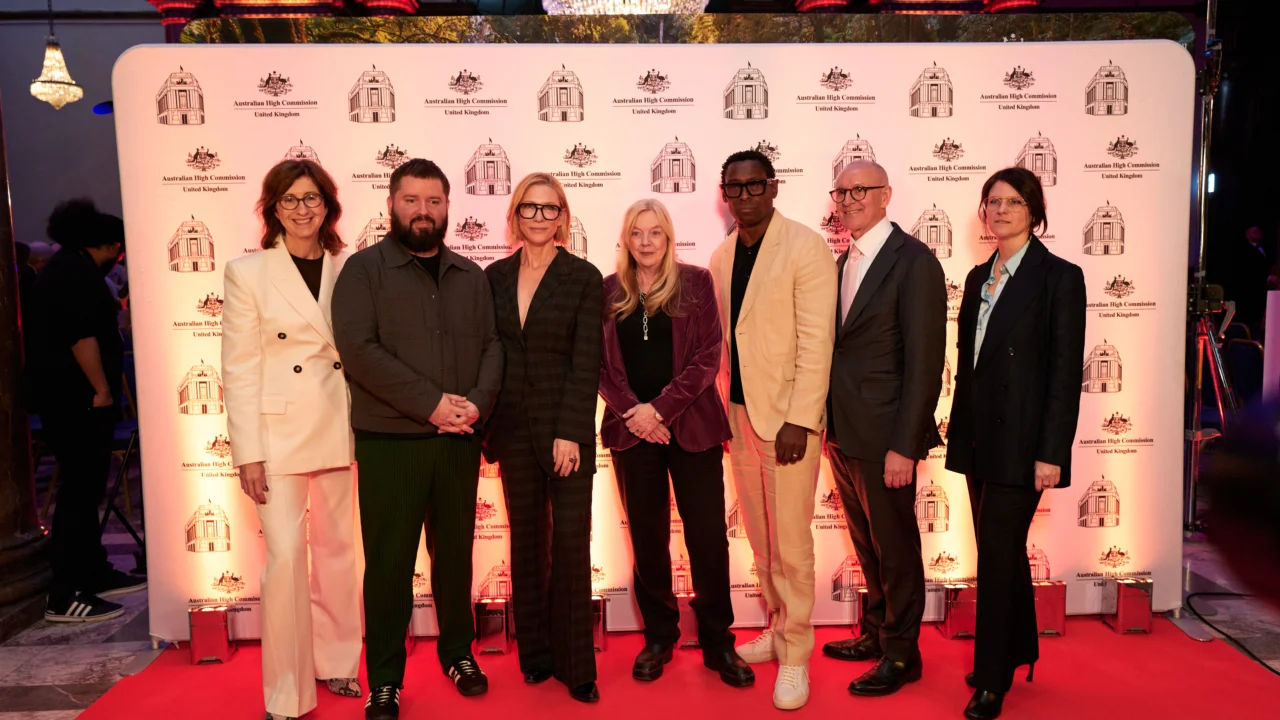
The two-time Academy Award winner was speaking at Australia House in London, where she joined acclaimed playwright Suzie Miller and director Kip Williams for a panel discussion presented by the National Institute of Dramatic Art (NIDA) and the Australian High Commission.
Together, the three NIDA alumni explored the training, experiences and cultural influences that have helped shape their international careers, identifying curiosity, resilience and a willingness to take risks as defining characteristics of Australia’s creative community.
For Blanchett, whose career spans independent cinema, Hollywood blockbusters and the world’s leading theatre companies, artistic development is an ongoing process rather than something that ends with formal education.
That curiosity was a recurring theme throughout the discussion, with all three reflecting on the importance of experimentation and the creative freedom afforded by their early training.
Williams, whose acclaimed adaptation of The Picture of Dorian Gray has enjoyed successful seasons in Sydney, London and New York, argued that one of the most valuable aspects of drama school is the opportunity to make mistakes without fear of professional consequences.
“It was extraordinary in that sense to give you a chance to fail and fail and fail and take risk and find your voice really,” Williams said.
For the director, whose work encompasses theatre, screen and opera, that freedom to experiment is fundamental to developing an individual artistic identity.
Williams has become one of Australia’s most internationally celebrated theatre directors following the success of The Picture of Dorian Gray, his technically ambitious adaptation of Oscar Wilde’s novel.
The production, which combines live performance with an elaborate system of cameras and video projections, features Australian actor Sarah Snook portraying 26 characters in a theatrical tour de force.
Following its Australian success, the production transferred to London’s West End and Broadway, earning major international recognition, including Olivier and Tony Awards for Snook’s performance.
Williams suggested that the willingness to embrace unconventional ideas is among the qualities that distinguish Australian performers internationally.
“There’s a fearlessness in our actors,” he said.
He also pointed to Australia’s cultural diversity as an important influence on the country’s creative identity.
“There’s also incredible cross-pollination of cultures in Australia, from our remarkable First Nations culture through to the waves of immigration.”
For playwright and screenwriter Suzie Miller, another NIDA graduate who has achieved international acclaim, Australia’s creative success can also be traced to a more pragmatic quality: determination.
“There’s so much talent in Australia,” Miller said. “I sometimes think it’s down to kind of old-fashioned grit.”
Miller’s own career offers a compelling example of that persistence.
Her breakthrough play Prima Facie, a powerful examination of the legal system and sexual assault, became an international theatrical phenomenon, with Jodie Comer winning both Olivier and Tony Awards for her performance in the one-woman production.
The play’s success has since extended beyond the stage. Miller adapted Prima Facie into a novel, while a screen adaptation starring Cynthia Erivo is also in development.
Although Miller describes theatre as “her great love,” she acknowledged that working across different mediums allows her to revisit ideas and characters that might otherwise be lost during the writing process.
The discipline of playwriting, she explained, often requires substantial material to be discarded as a work takes shape.
“I have lots of other piles, what I call the scenes that are in the garage waiting and hoping to have breath breathed into them,” she said.
Miller’s latest theatrical success, Inter Alia, has further strengthened her international reputation. Starring Rosamund Pike, the play enjoyed a successful London season and is scheduled to open on Broadway on November 10.
Like Prima Facie, Inter Alia explores the complexities of contemporary life through a deeply personal story, reflecting Miller’s ability to combine urgent social questions with compelling drama.
The international achievements of Blanchett, Miller and Williams also underscore the influence of Australian training institutions on the global entertainment industry.
NIDA’s alumni include some of the country’s most recognisable performers and creative practitioners, with graduates establishing careers across film, television and theatre in Australia and overseas.
Yet the discussion at Australia House suggested that the institution’s contribution extends beyond teaching technical skills.
For Blanchett, Williams and Miller, the foundations of a sustainable creative career are built on intellectual curiosity, the confidence to experiment and the resilience to withstand inevitable setbacks.
Their experiences also challenge the notion that international success requires Australian artists to abandon their creative identities.
Instead, the qualities they identified — cultural openness, resourcefulness, determination and a willingness to challenge convention — are precisely those that have helped Australian talent establish a distinctive presence on the world stage.
And perhaps that is the real secret to Australia’s creative success. It’s not simply about producing exceptional talent, but about fostering artists who remain curious enough to keep learning, courageous enough to fail and determined enough to try again.