

Going Down and Coming Back
Stephen Vagg looks at the latest hit Australian film in cinemas, which happens to be more than forty years old.
You can never predict what makes a cult movie. It’s the fans who decide that, and even then they can take their own sweet time about it. It was more than forty years before the wider world discovered the joys of Going Down, by which time many of the people who worked on it had passed away. Nonetheless, as producer-writer Haydn Keenan told The Hollywood Reporter Australia, “We got there in the end.” The movie is currently enjoying sell-out sessions across Australia.
For those unaware, Going Down is a 1982 Australian feature about four twenty-something Sydney women having one last night on the town before one of them moves to New York City. It’s sort of a female American Graffiti for those who came of age under Malcolm Fraser.
The script was originally written by Moira MacLaine-Cross and Julie Barry, based on their own experiences. In 1980, MacLaine-Cross approached producer Haydn Keenan, then best known for 27A (1974), who was looking for a project after leaving Martin Sharp’s legendary, and ultimately unfinished, documentary on Tiny Tim.
Keenan recalls the script was “just a few pages of handwritten material covered in claret”, but says “it was alive. It hadn’t had the life drained out of it.” He adds that MacLaine-Cross, who also receives an “original idea” credit, “was the real heart and soul of the project.”
A longer script was developed in collaboration with Melissa Woods, and the movie was originally shot in Sydney in August 1980 over a three-week period on a budget of just $5,000 under the direction of Keenan and Woods.
The four leads were played by Barry, MacLaine-Cross, Tracy Mann (“I cast her after seeing Hard Knocks,” says Keenan) and another actor who later left the project, as did Woods, who ultimately received a credit for “additional directed material”.
It was decided the movie needed more work. Keenan raised $50,000 for further filming and became sole director, while the departing female lead was replaced by Vera Plevnik, who had won a 1979 Logie for The John Sullivan Story. Going Down was largely reshot in August 1981.
The film was still being edited, with only a few pickup shots remaining, when Plevnik died in a car crash in January 1982. Keenan was forced to use a double for the remaining scenes involving her character.
Keenan secured a further $200,000 through 10BA tax concessions to complete the film, although there was no direct government investment. Appeals for help resulted in soundtrack contributions from James Reyne, a close friend of Plevnik’s and, according to Keenan, “a real champion of the movie”, as well as Pel Mel and others.
Going Down screened for the first time at the 1982 AFI Awards, but wasn’t released in cinemas until the following year. It attracted strong reviews, including one by Meaghan Morris in The Australian Financial Review, which Keenan notes “had investors waving it around the stock exchange to their 10BA mates who had avoided tax by financing shit.”
The movie enjoyed a three-month run at Sydney’s Roma Cinema but was, according to Keenan, “an unmitigated disaster in Melbourne”, partly because it opened in a porno house and audiences were expecting a very different type of movie based on the title.
The film screened at several overseas festivals, including Sundance, before gradually slipping into obscurity, aside from a small group of passionate devotees.
Then, more than forty years after the film was completed, a DVD copy of Going Down was discovered in a remainder bin in New York City by American distributor Elizabeth Purchell, who was launching her own distribution company. She loved the film and licensed it for theatrical screenings across the United States.
The response was particularly strong among younger female audiences, prompting Keenan to re-release the movie in Australia. Since then, Going Down has played in cinemas throughout the country, frequently topping box office charts for the best screen average of any Australian film.
“The picture seems to be developing a momentum of its own,” says Keenan. “All the screens are adding sessions and extending seasons. More cinemas are coming onboard.”
He credits much of the resurgence to a social media strategy aimed directly at younger audiences.
“Overseen by filmmaker Billy White, we’ve used a guerrilla social media campaign that gets straight to the kids,” says Keenan. “And they’ve responded in droves. They’re coming in and partying. We even had one guy thrown out for being too drunk!”
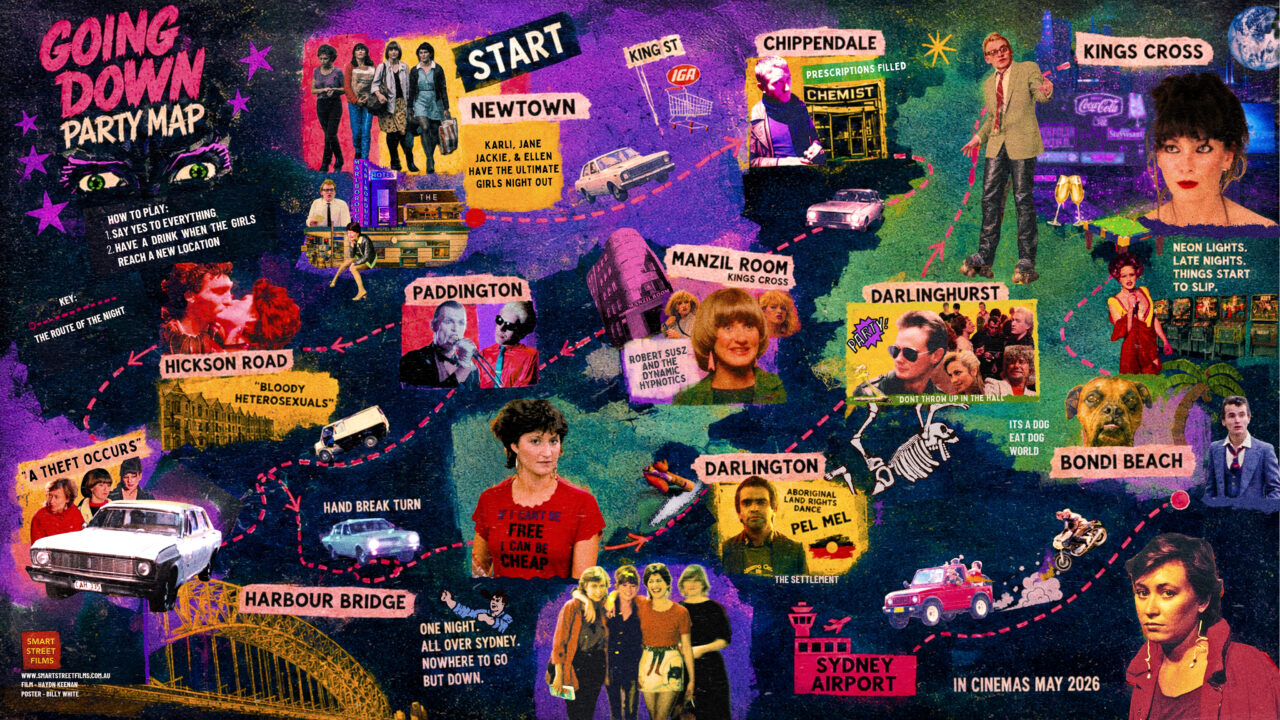
Keenan has also embraced old-school ballyhoo marketing techniques, including hiring an actor to protest the film outside cinemas and distributing maps tracing the characters’ movements through Sydney during the story.
So what about the movie itself?
Going Down follows four friends in their early twenties. Karli (Tracy Mann) is flying to New York the next morning, sensible but still eager for one last blowout. Jane (Vera Plevnik) is a hard-drinking hot mess who resents Karli’s wealthier background while simultaneously dreading her departure. Jackie (Julie Barry), squeezed by the cost-of-living crisis, considers sex work as a way forward, while the slightly daggy Ellen (Moira MacLaine-Cross) pursues public servant Greg (David Argue).
Aside from Mann, Plevnik and Argue, who plays a dual role, familiar faces include Esben Storm, Richard Moir, Steve J. Spears, Gary Foley, Hugh Keays-Byrne, Lisa Peers and barrister Charles Waterstreet. A very young Claudia Karvan and future director Samantha Rebillet also appear briefly as children outside a chemist.
Going Down is often described as “gritty”, though “accurate” might be the better word.
The women drink, take drugs, have sex and live in chaotic share houses, but not because the film is making some grand nihilistic statement. It’s simply how they live. They enjoy the sex, drugs and beer. They live in dumps because that’s what they can afford. If the others have reservations about Jackie’s career choices, they still understand why she’s considering them. If the group surrounds itself with sketchy men, well, who hasn’t?
Almost every issue explored in the film still resonates with young women in Sydney in 2026, “although it’s harder to find a car park in Kings Cross,” Keenan jokes.
The quality of the acting varies, but everything is anchored by a star-making performance from Tracy Mann. The film’s secret weapon, however, is David Argue, operating at full manic, scene-stealing force.
The production values are astonishingly strong for such a low-budget film. Keenan captures Bondi Beach, the Harbour Bridge and Kings Cross in all their grimy splendour, alongside pubs, clubs, parties and late-night Sydney streets, all backed by a terrific soundtrack.
“We benefited from capturing Sydney at the time,” says Keenan. “I’m a great believer in quality second-unit photography. There was something pulsating about the city and we got it on camera.”
Going Down brushes up against major themes, class, sexual politics, violence against women, Aboriginal land rights, queer culture, sex work and police corruption, but rarely in a heavy-handed way. These elements exist more as part of the atmosphere surrounding the characters than as overt political messaging.
What lingers is the texture of the film, the humour, melancholy, friendship and emotional messiness. The Sydney it depicts has largely been cleaned up, and arguably dulled down, but the character types and emotional dynamics remain strikingly contemporary.
Aside from Plevnik, many of the cast and crew have since passed away far too young, including Storm, Argue and Rebillet.
“There are melancholy ghosts all through the film,” says Keenan, “all in the flower of their youth.”
But they, and early 1980s Sydney itself, remain vividly alive in Going Down.
Going Down is currently screening in select cinemas.