
Holy Days Is Here
Director Nat Boltt turns grief, faith and three unforgettable nuns into the road movie we probably need right now
When Nat Boltt’s young son asked her a seemingly simple question—“Will we die together?”—she found herself confronting something that adults spend most of their lives trying to avoid.
How do you explain death to a child?
“I said, ‘No darling, we won’t die together. With any luck I’ll go first and you’ll live a long life … and I’ll wait for you.’ It didn’t help,” Boltt recalls. “He cried. Then I cried.”
That conversation became the emotional spark behind Holy Days, her feature directing debut, a warm-hearted New Zealand road movie that somehow manages to juggle grief, faith, eccentric comedy and a trio of unforgettable elderly nuns without losing its emotional centre.
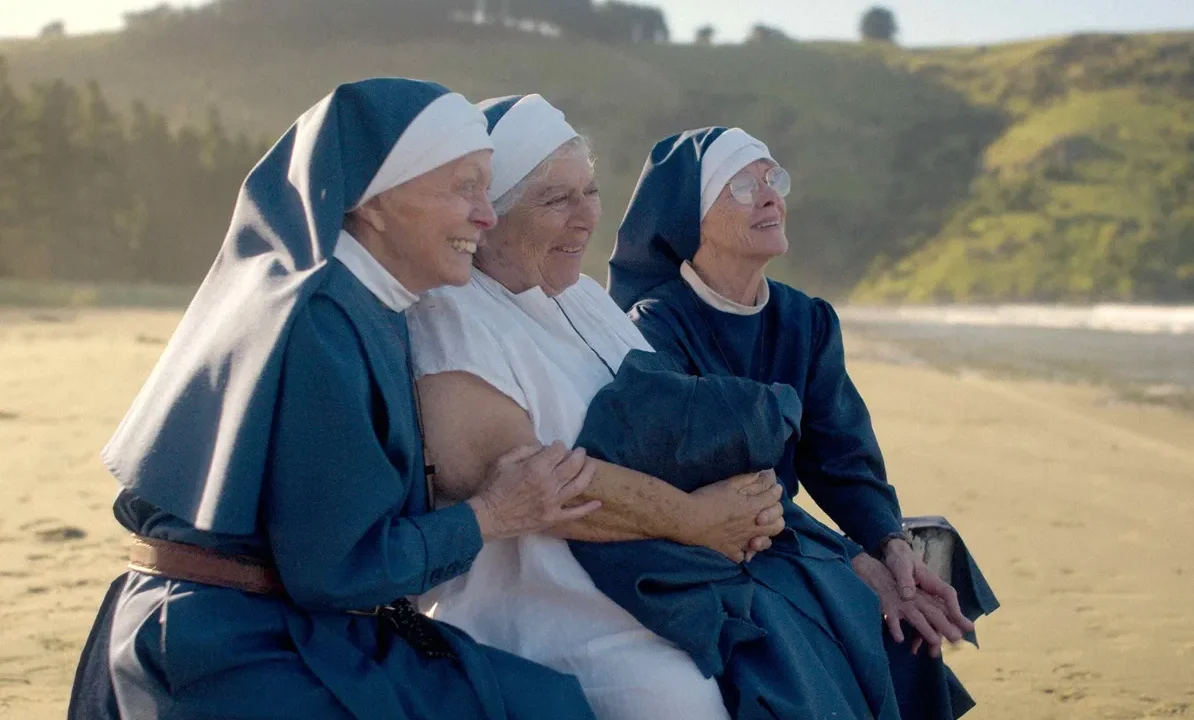
Adapted from Dame Joy Cowley’s beloved novel, Holy Days follows young Brian, a boy devastated by the death of his mother. Convinced he can somehow reach heaven—and stop his father from replacing his mum—he joins three elderly nuns on an increasingly chaotic journey across New Zealand. Along the way come stolen cars, crooked officials, fishmongers, road chases and unexpected miracles, all wrapped inside a story that’s ultimately about accepting loss rather than escaping it.
For Boltt, however, the film was never simply about a road trip.
“The loss of a loved one is simply not something humans can bear,” she says. “We just don’t have the patience to wait for the reunion, because we are so afraid of the pain of a broken heart.”
Rather than offering easy answers, Holy Days asks audiences to sit with grief while finding humour along the way.
“We make a film,” Boltt says simply.
That balance between heartbreak and comedy became central to the screenplay.
“I like to weave comedy into everything, because how else do you get through your day?” she says. “I wanted to deal with the serious topic of death and serve it with a spoonful of sugar.”
The result feels closer in spirit to Little Miss Sunshine than a conventional family drama, something Boltt readily acknowledges. Growing up on films such as Stand By Me, The Goonies and The Dark Crystal, she wanted to make the sort of movie she believes audiences have been missing.
“I grew up with such great films,” she says. “They’re the stories that remind you of how simple and wonderful and joyful the world can be.”
One of the film’s biggest talking points will undoubtedly be its cast.
Judy Davis, Jacki Weaver and Miriam Margolyes play the three nuns at the heart of the story, while newcomer Elijah Tamati takes on the pivotal role of Brian.
For a first-time feature director, assembling three performers of that calibre could have been intimidating.
Instead, Boltt saw it as validation.
“The biggest compliment is to have someone read your script and go, ‘I think this is a good story, a story well told, and I want to tell it with you.’”
Margolyes was always her first choice.
“I always had Miriam Margolyes in my mind,” Boltt says. “She’s rambunctious and playful, the naughtiest little kid in the form of an octogenarian.”
Judy Davis quickly became the obvious choice for the formidable Sister Agnes.
“She has that incredible comedic timing and the X-factor of drama,” Boltt says. “When she came on board, my knees went weak.”
Jacki Weaver completed what Boltt affectionately calls “the perfect three.”
Together they form the emotional backbone of a film that also makes a quietly radical point about ageing.
“I wrote Holy Days as a celebration of life—and yes, ageing,” Boltt says. “It challenges the invisibility of older women on screen and in our culture.”
She is refreshingly blunt about what motivated that decision.
“Where are our older creatives? Why on Earth aren’t we celebrating them at every stage of our creative journey?”
It’s a question Hollywood rarely asks.
Instead of treating older women as comic relief or background characters, Holy Days places them firmly at the centre of the adventure, giving Davis, Weaver and Margolyes roles that are funny, vulnerable, stubborn and heroic in equal measure.
The film also embraces Māori ideas of ancestry and belonging, grounding Brian’s emotional journey in New Zealand’s cultural landscape. Guided by cultural producer Tainui Stephens, Boltt spent time learning about Aoraki and the stories surrounding the sacred mountain before cameras rolled.
“We got to listen to the elders speak about everything of that area and the incredible significance of the mountain,” she says. “It was hugely special and a great honour.”
Visually, Holy Days blends live action with stop-motion animation, using the imagery of a snow globe to reflect Brian’s emotional state.
At its heart, Boltt says, the snow globe became the film’s defining metaphor.
“Life and death. Youth and age. Departure and return. Like snowflakes inside a globe—shaken, unsettled and resettled again.”
For Boltt, that’s ultimately what Holy Days is about.
“In a world that clings to youth and fears death,” she says, “Holy Days dares to make ageing joyful, grief magical and death part of life’s great continuum.”
It’s an ambitious goal.
Judging by the warmth, humour and emotional honesty at the centre of the film, it’s one she may well have achieved.
Mitchell Peters
Holy Days is in cinemas now