
‘Greatest Copyright Theft in History’: AWG Boss Sounds Alarm on AI
The impact of Artificial Intelligence technology on the global economy and the business world has dominated headlines throughout 2026.
As Big Tech seeks to transform working life throughout the community with AI, creatives are facing the scourge of copyright theft.
Now HOLLYWOOD REPORTER AUSTRALIA begins an investigation into the impact of the disruptive power of AI in the creative communities Down Under.
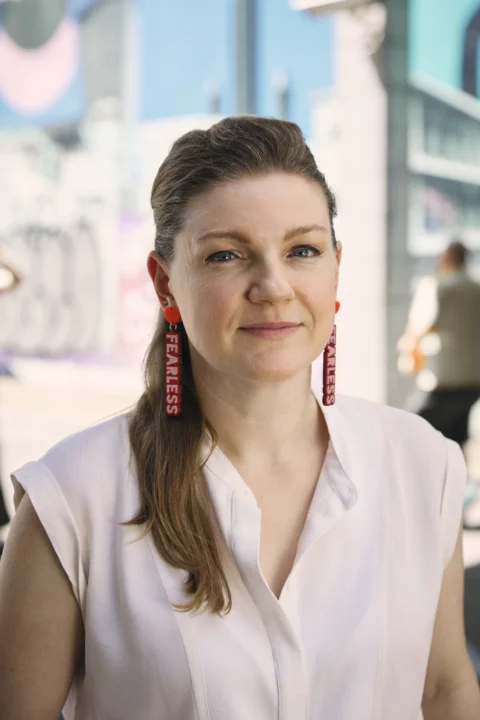
In the first of a series of articles, PETER GALVIN speaks to Claire Pullen, the Chief Executive Officer of the Australian Writers Guild and the Authorship Collecting Society Australia Aotearoa (ACSAA).
In July, Prime Minister Anthony Albanese launched the Office of AI, and for the creative industries Down Under, the announcement came not a moment too soon.
The stated aim of the OAI is to ‘coordinate across Australian Government agencies to design and legislate the new Australian artificial intelligence (AI) standard and unlock AI training in Australia.’
Brands like Anthropic and Google are set to build data centres in Australia; meanwhile, they continue to seek ways to ‘harvest’ content to train AI tools.
For Claire Pullen, CEO of the AWG and the ACSAA, Big Tech’s characterisation of Australia’s copyright laws as a ‘problem to be solved’ is an affront.
In a statement following the Prime Minister’s announcement, Pullen commented that Australia’s copyright laws are an “opportunity to create new markets, to add to the billions creative workers generate.”
She added: “Australian stories are a critical part of our shared future, supported by the right copyright settings…our Prime Minister made it clear that theft of creative works is unacceptable, and Australia is ready for the opportunities ahead.’
In the following interview, Pullen discusses the feedback from members who have reported the harmful effects of AI on their work lives.
Pullen also outlines the broader moral and ethical issues surrounding the take-up of AI.
Hollywood Reporter Australia: The AWG has been active in raising awareness about the potential and actual threats Artificial Intelligence technology poses to creatives for several years. Can you pinpoint the moment when AI emerged as a ‘menace’?
AWG and ACSAA CEO Claire Pullen: The first place that it impacted our members was in games. It’s one of the fastest-growing sectors of screen content.
HRA: When was this?
Pullen: It was about 18 months before the Writers Guild of America strike in 2023.
[Ed: The controversial WGA strike in the US lasted 148 days, with AI regulation a central issue].
HRA: The Interactive Game and Entertainment Association (IGEA) announced in March that the sector generated $608 million in 2025. And Screen Australia is heavily invested in supporting developing creatives in the sector with $3 million in 2023-2024.
Pullen: Yes! Our members in the sector pushed me about [AI], and they kind of said…’Our [writing] rooms are getting smaller; we’re getting originating material that’s not as good.’
HRA: An issue dominating the conversation around AI and its impact on creatives across all sectors – music, all forms of literature, all sound and image content – is Big Tech’s role in ‘harvesting’ copyright material for training AI tools. Has that touched AWG members?
Pullen: I had a couple of our playwright members get in touch and say, ‘Hey, I’ve gone online, and I’ve checked, and my plays are in there’.
HRA: Obviously an alarming issue is AI’s potential to eliminate employment opportunities and disrupt career pathways. In May, the AWG alerted members to a story that was circulating in the Australian TV and film sector. It detailed how certain production companies were using AI in the writer’s room, making the job of note taker redundant. It’s a highly sought role for emerging writers.
Pullen: Yes. You know, how do we get more screenwriters if we don’t train them?
HRA: What kind of experience have you had with big tech when it comes to getting a hearing for your concerns about AI?
Pullen: It’s only really in the last [few months] with some very public shaming and a lot of lobbying with government that any of the big tech companies have even reached out to us.
HRA: Traditionally, the culture of big tech is one of ‘mavericks’, rebels and innovators who are adjacent but separate from the mainstream sector they seek to disrupt.
Pullen: That is exactly right.
HRA: Digital tech has totally remade the creative process in method and approach for more than two decades. But with ‘harvesting’ of IP without consent, we have moved on from a story of assimilation to an existential threat to the entire creative community. How could this happen?
Pullen: I think they see themselves as having an elevated understanding beyond the rest of us…
HRA: Can you speculate for a moment about where this attitude you describe might take the AI-Creative story in Australia?
Pullen: I’m a big believer in the idea that you don’t listen to what people say. You look at what they do. [The big tech behind AI] have committed the greatest act of copyright theft in the history of the world.
HRA: The ‘harvesting’ of IP came back on Big Tech company Anthropic last year when they settled a US$1.5 billion class-action copyright lawsuit.
Pullen: They [Big Tech] thought that they would get away with the pirate databases, the scraping of the internet, the transcribing and stealing of audio-visual content and music…
And they thought they were going to get away with it either because they’ve got advice that says legally ‘it’s okay in the US’ or they did it and then came up with the justification after.
So my sense would be that we’re not going to see any change in [Big Tech’s] approach on how they want to deal with that.
They view us [creatives] as a huge inconvenience, in that they have to deal with us at all. Government keeps telling them to go and talk to license holders, rights holders and get consent…
HRA: What is your experience of meeting with Big Tech and stakeholders in AI?
Pullen: In the meetings I’ve had, they [appear] to be incredibly frustrated that they have to talk to us at all – we are ‘in the way’…they are incredibly dismissive.
Look, I don’t want to say, ‘they’re all the same’, but in meetings I genuinely can’t tell if they’ve done any [research] to look into how AWG members’ work has been impacted or might be impacted.
Pullen says that in a meeting with one large tech company, their reps admitted that they did not know whether AWG members’ work was in the AI models they use – because they had not investigated the issue.
Pullen: I was like, ‘well, should you not have looked before the meeting?’
HRA: What’s the AI story look like for the film and TV sector as 2026 unfolds?
Pullen: Here in Australia, TV is getting more and more expensive to produce by the hour. There are fewer and fewer people in work [as a result].
The traditional kind of production pipelines…we’re all being bypassed by the direct-to-consumer content that’s going up on YouTube or Spotify or Instagram or TikTok.
HRA: Micro-dramas, content like that?
Pullen: Yes! So…I won’t say the AI [situation] has hit us at the worst possible time, but it has hit us at a weak point.
There’s a pile of [issues], each of which on its own would be a big enough [challenge] to film and TV. And then you add AI on top.
ENDs